Backflow testing for commercial buildings: what it is and what happens
A backflow preventer is a small assembly with a big job, and testing it is how you find out whether it's still doing that job.
October 27, 2026 · 4 min read
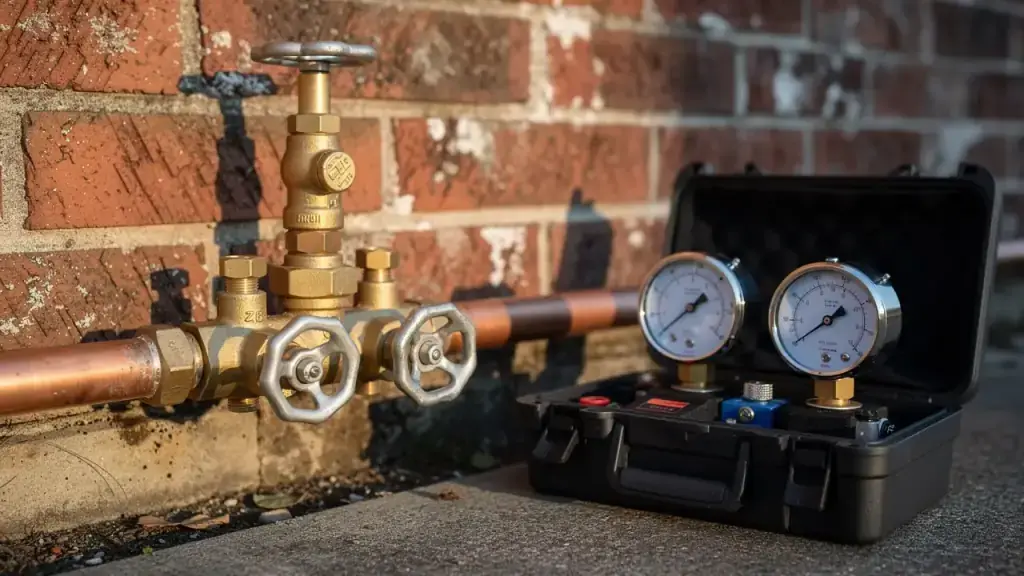
Most building owners and managers know the backflow preventer as a brass assembly near the water line that nobody touches. It doesn't look like much. But it's there to protect the drinking water, and like any mechanical part, it can wear out, foul up or stop sealing without anyone noticing. Testing is how you find out.
What backflow is
Water in a plumbing system is meant to move one way: from the supply into the building. Backflow is when it moves the other way. That can happen when pressure in the supply drops or when pressure on the building side climbs higher than the supply. When water reverses, whatever it picked up inside the building can head back toward the clean supply.
That's a concern anywhere a building's plumbing touches something that shouldn't get into drinking water: irrigation, boilers, kitchen equipment, fire systems, process equipment and so on. A backflow preventer sits in the line to stop the reversal.
How a preventer works
Backflow assemblies come in several designs, but the idea is the same. Spring-loaded check valves let water pass forward and close when it tries to go backward. Some designs add a relief valve between the check valves that opens to vent water out if something goes wrong, so it doesn't pass through. Springs, seals and seats are the parts that wear.
Debris, mineral scale and age can keep a check valve from closing fully. From the outside, the assembly looks the same. The only way to know whether it holds is to test it.
What a backflow test involves
A tester connects a gauge set to the test ports on the assembly and works through the valves in a set order, reading pressures at each stage. The gauges show whether each check valve holds against reverse pressure and whether the relief valve opens when it should. The test takes the assembly's performance and turns it into numbers someone can read and write down.
If everything holds, the result is recorded. If a part doesn't, the tester can see which one. That's why backflow testing and backflow repair go together. A failed check valve often comes down to a fouled seat or a worn spring or seal, and the repair is frequently a matter of cleaning or replacing those parts and then testing again to confirm.
The water to the building may be shut off briefly while the work is done. It's a good idea to ask ahead about timing, particularly where water service can't be interrupted without planning.
Who does the test
Testing calls for a person who knows how to read an assembly's behavior and who holds the right license for the work. Charlie Mitchell, the owner of Lonestar Plumbing & Backhoe Service, obtained his Backflow Inspector License in 2004. He's been in plumbing since 1974, with his Journeyman's License in 1976 and his Master's License in 1980.
Buildings that commonly have them
We do commercial plumbing for a wide range of buildings, single story to multi-story. Backflow assemblies are part of the plumbing in many of them:
- Schools and churches.
- Restaurants and other food service.
- Retirement homes and hospitals.
- Offices and malls.
- Retail space and warehouses.
- Movie theaters and maintenance buildings.
If your building isn't on that list, don't assume it's different. If you have irrigation, a boiler, or equipment that ties into the water supply, there may be an assembly on your property worth knowing about.
Questions to settle with your water provider
We're not going to guess in a blog post about what your particular building needs or on what schedule. That depends on your property and your water provider, so it's worth confirming with them directly. What we can do is explain what a test involves and carry it out.
Here is what we'd suggest keeping together for your building:
- The location and type of each assembly on the property.
- The written results of each test, with the date.
- Notes on any repair that was done and the retest afterward.
- A contact who knows where the shutoff valves are for the building.
A tidy record saves time the next time somebody asks, and it makes it much easier to spot an assembly that keeps failing.
Planning the visit
For a commercial job, we'll talk through the building, the number of assemblies and any hours when water has to stay on, then plan the work around that. The estimates depend on what the building needs, and we give them free.
Lonestar Plumbing & Backhoe Service is family owned, has served the Grandview, TX area for over 40 years, and always has a licensed plumber on every job. To talk through backflow testing or repair, call or text (817) 648-9946, Monday to Friday, 7:30 am to 5:00 pm. More on the building side of our work is on our commercial plumbing page.
Lonestar Plumbing & Backhoe Service, (817) 648-9946
Call (817) 648-9946More articles
Why we dig to a broken sewer line instead of jackhammering your slab
A broken sewer line doesn't always mean a torn-up floor, and the first tool we reach for isn't a jackhammer.
Nine warning signs your water heater is failing
Most water heaters give some notice before they quit. Here are nine things to listen, look and smell for.