Why we dig to a broken sewer line instead of jackhammering your slab
A broken sewer line doesn't always mean a torn-up floor, and the first tool we reach for isn't a jackhammer.
October 27, 2026 · 4 min read
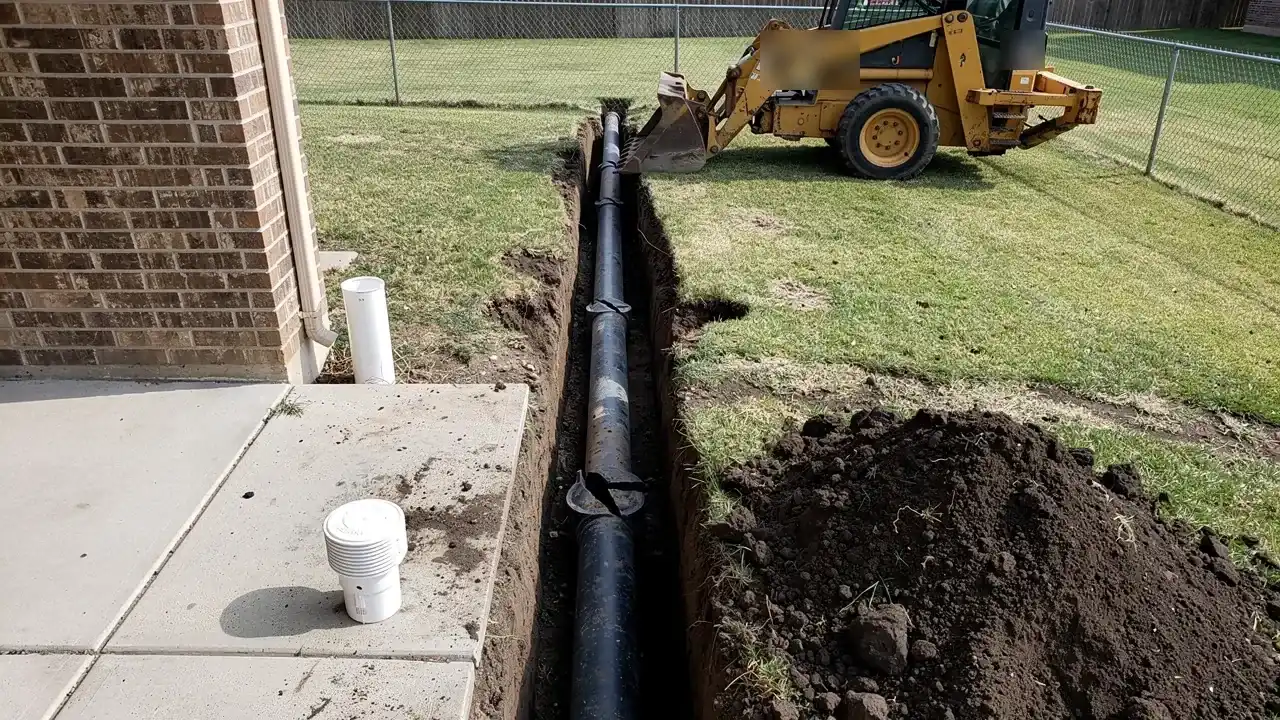
A broken sewer line rarely announces itself politely. It shows up as a drain that won't clear, a gurgle in the tub when the washer empties, a wet patch in the yard that never dries out, or a smell near the foundation. By the time you pick up the phone, you want two questions answered: where is the break, and how much of the house has to come apart to reach it?
At Lonestar Plumbing & Backhoe Service, our answer is to avoid the jackhammer wherever the job allows it. We find the failed section first, then use tunneling and excavation to get to it. The backhoe in our name is that second half of the work.
Find the break before anyone digs
Digging blind is how a small repair turns into a big one, so the first step isn't a shovel. A camera on a fiber optic cable goes into the line through a cleanout or another access point and shows what is happening inside the pipe. You might see a crack, a joint that has pulled apart, a low spot where the line has sagged and holds water, or roots that have pushed their way in. Our plumbing video inspection service covers how that works.
Once the break is located, the repair stops being a guess. You know how far the problem sits from the house, roughly how deep the line runs, and whether the damage is one spot or a long stretch of tired pipe. That decides everything that comes after.
Why the slab stays whole when it can
A concrete slab carries a lot of your house on its back. Breaking through it means jackhammer noise, concrete dust drifting through the rooms, and a patch afterward that rarely matches the rest of the floor.
Some jobs can't avoid the slab. If the failed pipe runs directly beneath the middle of it, cutting in may be the honest answer, and we'll say so once we've seen the footage. But many sewer failures happen where the line leaves the house or crosses the yard. The pipe is outside the footprint of the slab, or it can be reached from outside it. In those cases, excavation does the work.
A backhoe opens a trench along the line, the crew works down to the pipe, the bad section comes out, new pipe goes in, and the ground is closed back up. Tunneling is the related approach for getting past something you'd rather not tear up, like a walkway or a driveway, instead of opening it from the top.
What the dig actually looks like
Think of the yard as a cross-section. The surface is what you see: grass, gravel, a flower bed. Below it is soil, and somewhere down in that soil is the line that failed. Excavation is the straightest way to see that cross-section with your own eyes and fix the pipe with the ground open in front of you. In general, a dig like this goes in a few stages:
- The crew confirms the break's location from the camera findings, so the trench goes where the problem is rather than where it might be.
- The trench is opened with the backhoe and the pipe is exposed, so the master plumber can look at its condition directly instead of reading about it.
- The damaged section is cut out and replaced. Older homes often have cast iron drain lines, and cast iron has its own way of failing over decades.
- The repaired line is checked before anything gets buried again.
- The trench is filled back in and the yard is left ready for you to reseed or replant.
Old homes and old pipe
Cast iron was a common drain material for a long time, and plenty of it is still in the ground. It can crack, corrode and flake from the inside. One Google reviewer wrote about a long-term issue in a quaint old home and summed up the lesson in one line: "Run to Lone Star Plumbing with an issue on old cast iron pipes!"
That kind of job is where camera first, trench second makes sense. The pipe's actual condition tells you whether a spot repair will hold or whether a longer run should be replaced while the ground is open.
Questions worth asking any plumber
Before anyone digs up your yard or breaks concrete inside your house, it's fair to ask a few things:
- Do you have camera footage, or another clear reason, that shows where the line has failed?
- Can the repair be reached from outside the slab?
- What will the yard or driveway look like when you're done, and who handles that part?
- Who will be on the job? At our company there is always a licensed plumber on every job.
You'll notice we haven't quoted a price here. That's on purpose. A sewer repair depends on depth, length and what's in the way, and a number given without seeing the line is a guess. We give free estimates, and first-time clients get 10% off service calls, labor and materials.
Charlie Mitchell has been plumbing since 1974 and earned his Master's License in 1980. We've served the Grandview, TX area for over 40 years, and tunneling and excavation is how we repair broken sewer lines instead of leaning on jackhammer services.
If you think you have a broken sewer line, call or text (817) 648-9946. The office is open Monday to Friday, 7:30 am to 5:00 pm, and 24-hour emergency service is available. Our residential plumbing page lists the rest of what we do around the house.
Lonestar Plumbing & Backhoe Service, (817) 648-9946
Call (817) 648-9946More articles
Nine warning signs your water heater is failing
Most water heaters give some notice before they quit. Here are nine things to listen, look and smell for.
What sewer hydrojetting does, and why we assess the roots first
High-pressure water can restore a sewer line without chemicals, but only after someone has checked the pipe can take it.