What sewer hydrojetting does, and why we assess the roots first
High-pressure water can restore a sewer line without chemicals, but only after someone has checked the pipe can take it.
October 27, 2026 · 4 min read
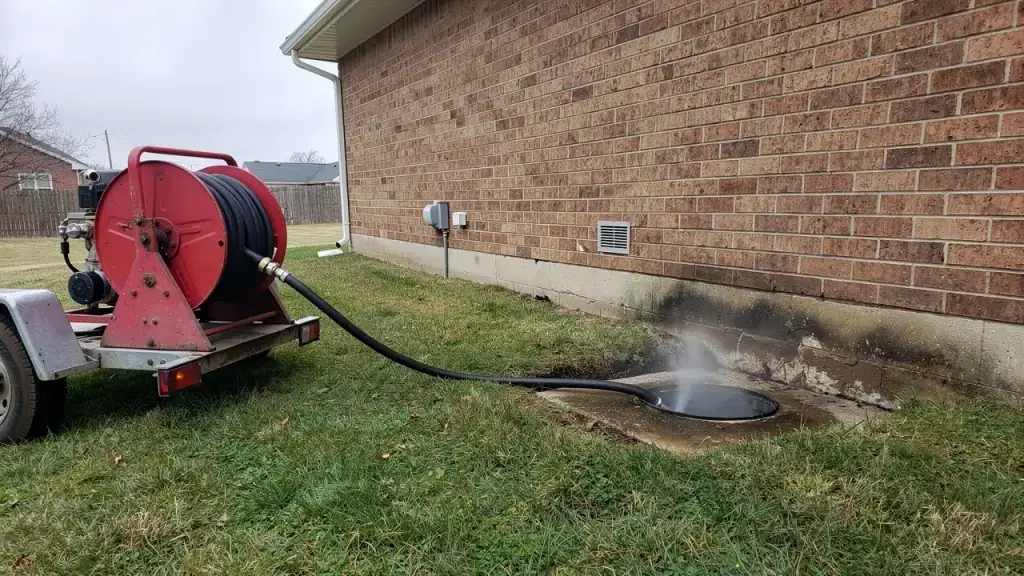
A slow drain that clears for a week and then slows again is telling you something. The clog you're clearing may not be the problem. It may just be the part of the problem that sits where a plunger or a snake can reach. Sewer hydrojetting goes after the whole buildup along the pipe wall, not just the plug in the middle.
How hydrojetting works
Hydrojetting sends high-pressure water through a specialty nozzle at the end of a hose that is fed into the sewer line, usually through a cleanout. Nozzles come in different designs. Some break through a blockage directly ahead, and others spray backward at an angle, which pulls the hose forward and scours the walls of the pipe as it goes. The water carries the debris back out along the line.
No chemicals are involved. It's water, pressure and the right nozzle for the pipe in front of the crew. That matters to a lot of homeowners, and it matters on properties with field lines, where harsh additives are the last thing you want to send through.
What it clears
- Sludge and grime that coat the inside of the pipe and narrow it a little more each year.
- Mineral deposits that harden on the walls.
- Grease that has cooled and clung to the pipe, which hydrojetting can lift away.
- Obstructions in field lines.
- Roots that have worked their way in, which the water can cut through.
The point of all that is to bring the pipe back toward its full capacity. A line that has narrowed to a fraction of its original opening will clog again no matter how many times you open the blockage. Cleaning the walls is what addresses that, and it is why hydrojetting is often described as a longer-lasting fix than clearing a single stoppage.
It works at small and large scale. A residential line from a house to the main and a long run serving a commercial building are both candidates, with equipment and approach matched to the job.
Why the master plumber assesses the roots first
Here's the part that a lot of quick-fix advertising skips. Roots don't just block a pipe. When they invade a line, they can damage the pipe itself and its protective sock, the liner that helps hold the line together. If roots have been in there for a long time, the roots may be doing double duty as the thing keeping a cracked section in place.
Blasting that out with high-pressure water without looking first can make a weak pipe worse. It's a bit like pulling a splinter that's been plugging a wound. So before we jet a line that has had root invasion, our master plumber assesses the damage. If the pipe can take it, we jet. If it can't, you're better off hearing that before the water goes in than after.
The camera comes first
The easiest way to assess a root-invaded line is to look at it. A camera on a fiber optic cable shows where the roots entered, how far they've grown and what shape the pipe is in around them. That footage lets the master plumber decide on jetting, on a repair, or on both in sequence: clear the line, camera it again, and then see what the clean pipe really looks like. Our plumbing video inspection service pairs naturally with hydrojetting for this reason.
If the camera shows a broken or collapsed section, jetting isn't the answer. That's a job for tunneling and excavation, where the crew digs to the failed section instead of tearing up the slab.
Signs a line might be ready for it
- Drains that slow down again soon after being cleared.
- Gurgling sounds from drains when something else is running.
- Several fixtures backing up at once.
- Odors near drains or cleanouts.
- A commercial kitchen or restaurant line that carries a lot of grease.
None of those prove you need hydrojetting. They're reasons to have someone look at the line. Sometimes a plain cleaning does it. Sometimes the line needs repair. The point of an assessment is to pick the right one.
What to expect when you call
We start with a conversation about what the drains have been doing and where the cleanout is. From there, the master plumber looks at the line, with a camera when it helps, and tells you what makes sense: jet it, repair it, or leave it alone. We give free estimates and we don't publish prices, because the right number depends on the line itself.
Lonestar Plumbing & Backhoe Service is family owned, and Charlie Mitchell has been in plumbing since 1974. There is always a licensed plumber on every job, which matters most on a job like this one where judgment decides how hard the water can safely hit the pipe.
If your drains keep slowing down, call or text (817) 648-9946, Monday to Friday, 7:30 am to 5:00 pm, with 24-hour emergency service available. You can read more on our sewer hydrojetting service page.
Lonestar Plumbing & Backhoe Service, (817) 648-9946
Call (817) 648-9946More articles
Why we dig to a broken sewer line instead of jackhammering your slab
A broken sewer line doesn't always mean a torn-up floor, and the first tool we reach for isn't a jackhammer.
Nine warning signs your water heater is failing
Most water heaters give some notice before they quit. Here are nine things to listen, look and smell for.